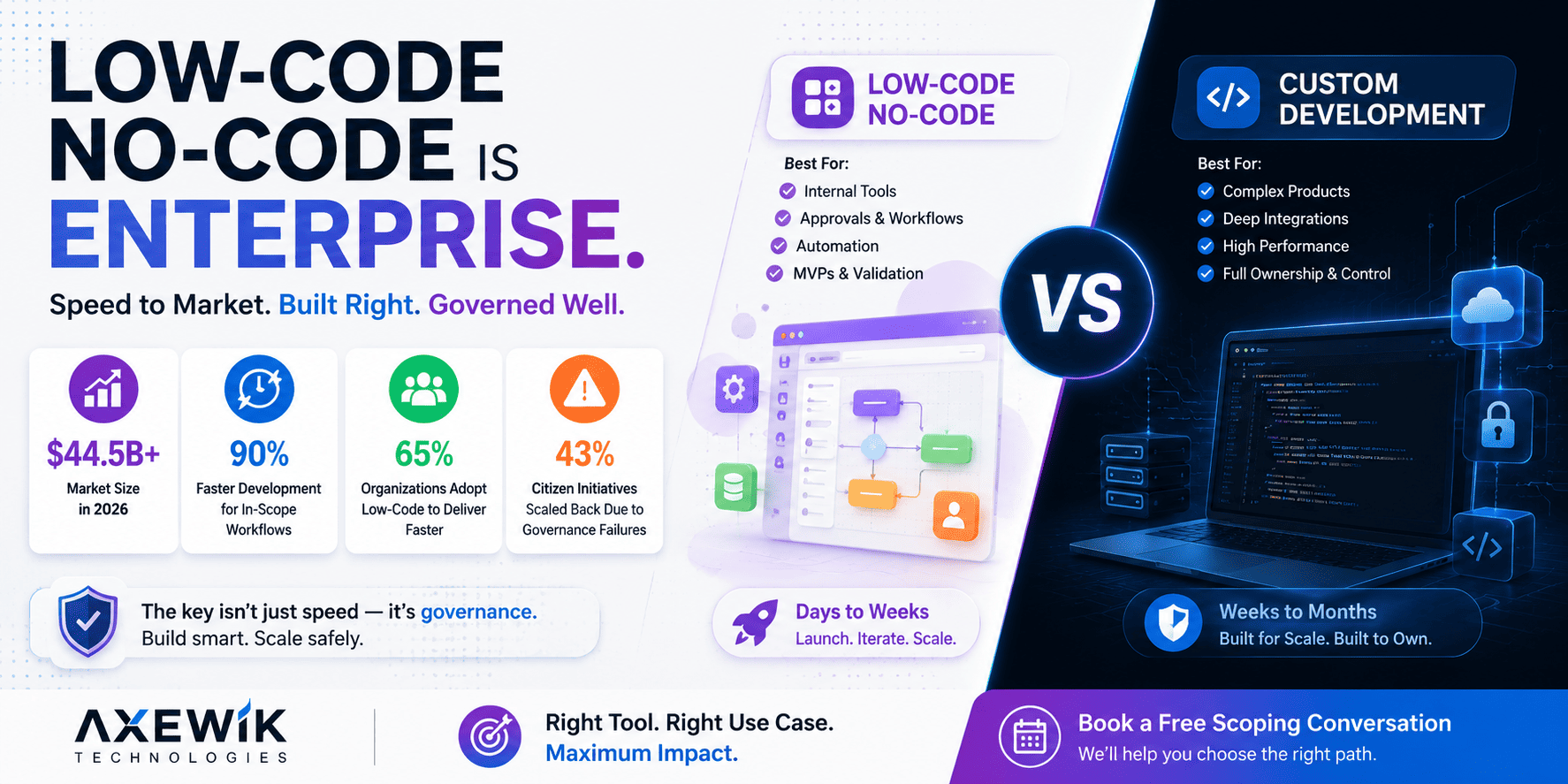
The low-code/no-code market has crossed into genuine enterprise infrastructure - $44.5-$52 billion in 2026, with Gartner projecting 75-80% of new enterprise applications built on low-code by year end. But the same research shows 43% of citizen-development initiatives launched in the prior three years were scaled back, paused, or shut down — almost entirely from governance failures, not technical ones. The decision isn't "is low-code legitimate now" (yes) - it's "does this specific workflow have a governance and complexity ceiling low-code can live inside."
The 2026 Numbers That Matter
- Market size: $44.5B-$52B in 2026, projected toward $376.9B by 2034 in some forecasts.
- 87% of enterprise developers already use low-code in some form - it's not a niche anymore, even among professional engineers.
- No-code reduces development time by up to 90% versus traditional coding for workflows within its capability range.
- 65% of organizations have adopted low-code tools specifically to accelerate delivery and reduce dependency on traditional development.
- The failure signal: 43% of citizen-development initiatives get scaled back or shut down - governance, not capability, is the actual bottleneck.
The Honest Comparison
| Low-Code/No-Code | Custom Development | |
|---|---|---|
| Timeline | Days to weeks; up to 90% faster for in-scope workflows | Weeks to months |
| Cost | Low, often subscription-based | Higher upfront, no platform lock-in |
| Governance | Requires deliberate guardrails or 43% failure risk applies | Built to your own governance model from the start |
| Ownership | You don't own the underlying platform | You own the codebase entirely |
| Ceiling | Real, and hit faster than most teams expect on complex workflows | Scales with proper architecture |
When Low-Code Genuinely Wins in 2026
- Internal operational tools, approval workflows, and departmental automation - this is where the 90% time-reduction number is real and consistently achieved.
- Validating a business idea before committing to a full custom build.
- Workflow automation specifically - 62% of current low-code deployments target this use case.
When Custom Development Is the Right Call, Not Just the "Bigger" Option
- The product IS the business - platform lock-in on your core product is a strategic risk, not a convenience trade-off.
- You need integrations, performance, or UI control beyond the platform's plugin ecosystem.
- You've validated the idea on no-code and hit its ceiling - the ideal sequencing, not a failure of the no-code phase.
The 2026-Specific Trap: "Vibe Coding" Without Guardrails
2025-2026 saw a surge in AI-generated low-code output ("vibe coding") that looks complete but turns out fragile once it faces real workflows or customers - the same pattern as unreviewed AI-generated custom code (see post #2), just at the low-code layer. The fix industry leaders are converging on: force smaller steps, require the tool to show its work, validate outputs before trusting them in production workflows.
Not Sure Which Side of the Line Your Project Falls On?
The low-code vs. custom decision is genuinely case-by-case - and getting it wrong in either direction is expensive. Axewik Technologies builds custom software and also tells clients honestly when a simpler path would serve them better; that's what a discovery phase is for. Book a free scoping conversation → and get a straight answer on which approach actually fits your workflow.