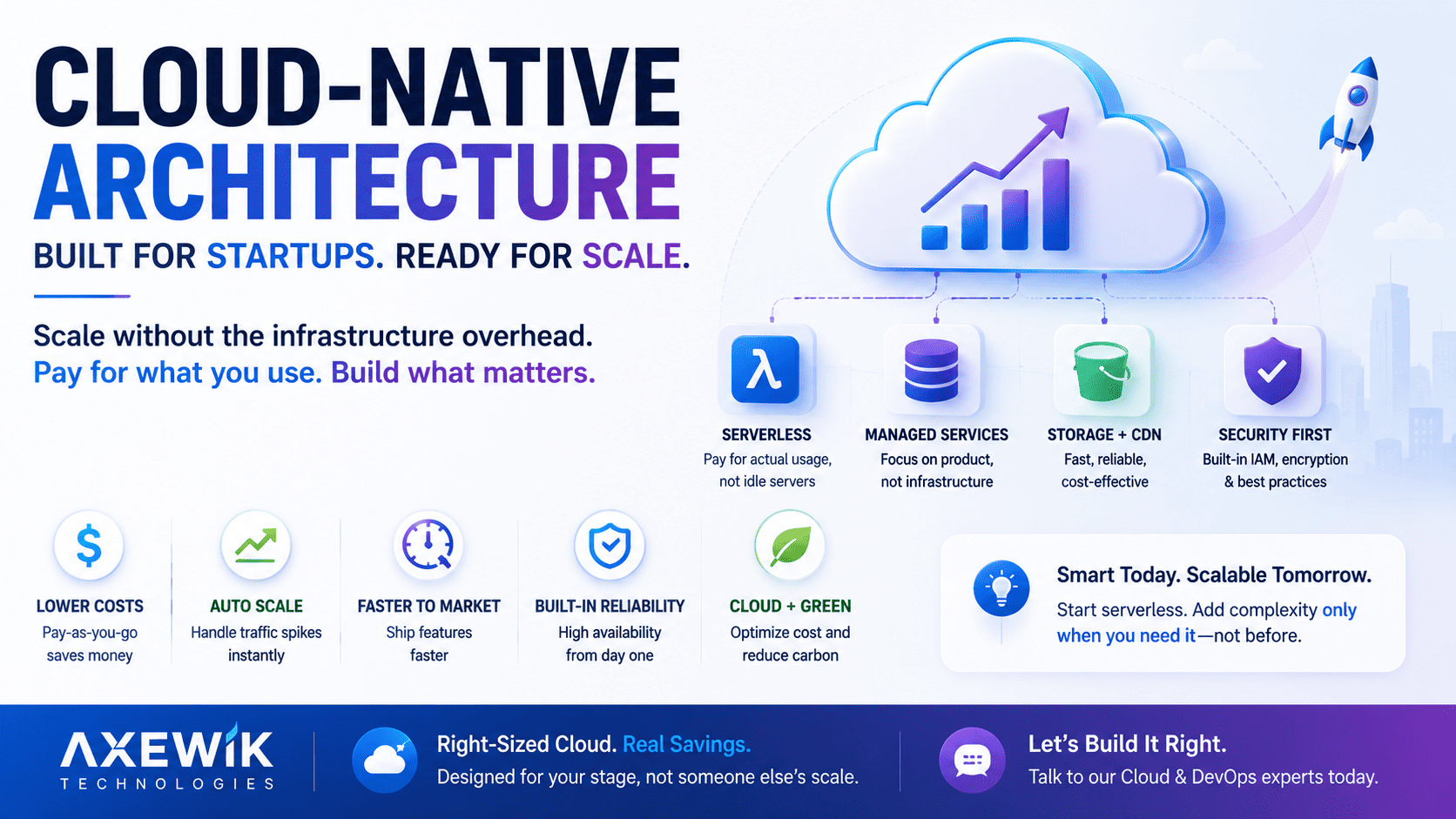
Cloud-native architecture lets startups scale without the capital expense of traditional infrastructure, but "cloud-native" isn't automatically cheap without cost discipline. The pattern that works for startups specifically in 2026: serverless-first for unpredictable traffic, deferring Kubernetes and multi-cloud until there's a concrete reason to need them, and cost monitoring built in from day one — not after the first alarming invoice.
What Cloud-Native Actually Means for a Startup (Not an Enterprise)
- Serverless computing (AWS Lambda, Azure Functions, Google Cloud Run) — pay for actual usage, not idle server time. The single highest-leverage cost lever for early-stage products with unpredictable traffic.
- Managed databases and services — a small premium traded for not needing dedicated infrastructure/DevOps headcount you don't have yet.
- Containers (Docker/Kubernetes) — genuinely useful once you're coordinating multiple services; premature complexity before that point.
The Startup-Specific Cost Traps
- Adopting Kubernetes before you need it. Powerful for coordinating many services; for a single early-stage product it's usually pure operational overhead without payoff - and it's consistently one of the most commonly over-adopted tools relative to actual need at the seed/Series A stage.
- Multi-cloud "for resilience" before product-market fit. Genuinely reduces vendor lock-in risk for mature companies; rarely justified pre-PMF given the added complexity cost.
- No cost-monitoring/alerting from day one. Serverless and cloud-native services are usage-billed — a bug or unexpected traffic spike can produce a real invoice shock before anyone notices without alerting configured.
- Ignoring energy/sustainability signals as a cost proxy. Cloud-aware carbon-tracking tools (AWS Graviton, GCP's Carbon Footprint tool) are increasingly bundled with cost-optimisation recommendations — using them isn't just an ESG checkbox; it often surfaces waste you'd otherwise miss.
A Practical Starting Architecture for Most Startups
- Managed database (not self-hosted) from day one.
- Serverless or container-based compute depending on workload predictability.
- CDN + object storage for static assets — cheap, and removes load from app servers.
- Cost alerts configured before launch, not after the first bill surprises you.
- Defer Kubernetes and multi-cloud until there's a specific, concrete reason to need them - "we might need it eventually" isn't that reason.
The AI-Workload Wrinkle in 2026
If your product includes AI features, factor compute cost differently - AI inference workloads have a different cost profile than typical web traffic (spikier, more compute-intensive per request), and the same serverless-first principle applies even more strongly here: pay-per-inference beats provisioning dedicated GPU capacity for unpredictable early-stage usage.
Get a Cloud Architecture That Scales With You - Not Ahead of You
The cheapest cloud architecture is the one matched to your actual stage, not the one built for scale you don't have yet. Axewik Technologies designs and implements cloud-native infrastructure for startups - serverless-first where it fits, with cost monitoring configured before launch, not after the first surprise bill. Talk to our Cloud & DevOps team → about a right-sized architecture for your product.