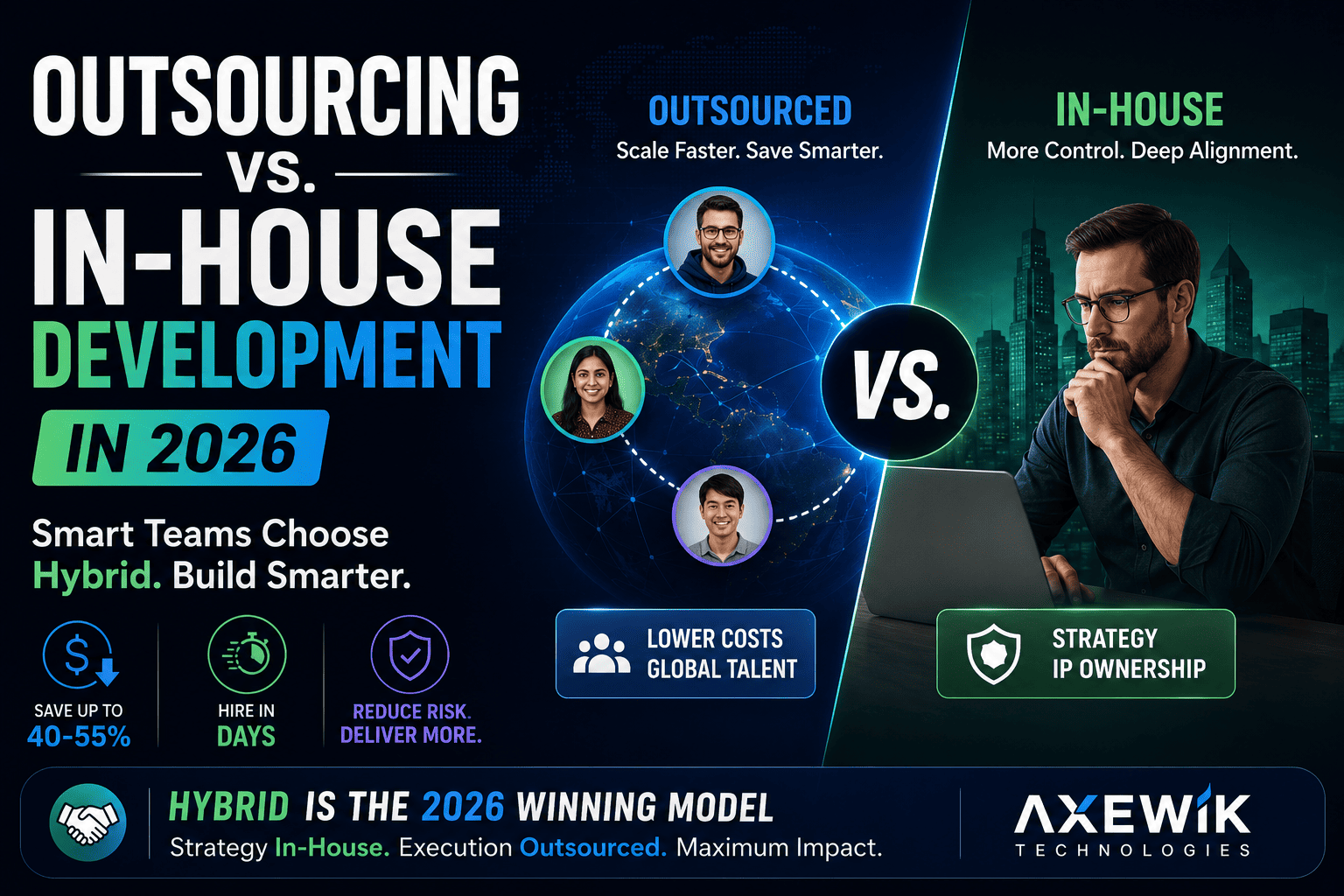
A fully-loaded in-house senior developer in the US now runs $200,000-$240,000/year in total compensation once you count benefits, recruiting, and ramp time — versus $55,000-$115,000 for equivalent offshore output. The global outsourcing market hit $618 billion in 2026 (heading to $977 billion by 2031), and the conversation has matured past pure cost-cutting into total-cost-of-ownership thinking. The 2026 default for most growing companies isn't picking one model - it's hybrid: product strategy and architecture in-house, execution capacity outsourced.
The Real Cost Comparison (2026 Data)
| In-House (US) | Outsourced | |
|---|---|---|
| Fully-loaded annual cost (senior) | $200,000-$240,000 | $55,000-$115,000 equivalent |
| Hourly rate | $80-$150 (up to $200 at top firms) | $20-$75 depending on region |
| Time to hire | 40-60 days mid-level, 3-6 months senior | Days to weeks |
| Regional rate examples | — | Ukraine: $40-$55/hr senior; India: $25-$50/hr; Philippines: $15-$35/hr; Eastern Europe: $45-$75/hr |
| Total offshore savings after overhead adjustment | — | 40-55% (not the headline 60-73%, once PM/tooling/governance is factored in) |
The hidden in-house math most founders underestimate: add roughly 30% to base salary for benefits and taxes before counting recruiting fees (15-25% of first-year salary) and 2-3 months of below-full productivity while a new hire ramps up. A "$130K developer" is closer to $169K+ before they've written meaningful production code.
Engagement Models, and Which Preserves the Most Value
- Dedicated team — the same offshore developers work on your product long-term. Closest approximation to in-house dynamics, best institutional knowledge retention, best model if the relationship will run 12+ months.
- Staff augmentation — works well when your in-house leadership retains architecture ownership and offshore developers execute within established patterns.
- Project-based — highest turnover risk since teams cycle between clients; fine for well-scoped, time-boxed work, riskier for anything requiring deep evolving context.
When to Choose Each
- In-house - the software IS your core competitive advantage, you're post-Series B with runway, and you need architecture/product decisions to compound in-house over years.
- Outsourcing - pre-revenue, capital-constrained, need niche expertise unavailable locally (AI/ML, specific frameworks), or building a time-bound project.
- Hybrid (the dominant 2026 pattern) - keep architecture, security, and product strategy in-house; execute with a disciplined outsourced partner. One detailed cost model showed this approach saving $10-20M over 3 years for a mid-sized platform team, versus either pure model.
What Actually Derails Outsourcing (So You Can Avoid It)
Communication issues affect roughly 42% of outsourcing clients. Scope creep drives 20-30% budget overruns. Quality issues lead to roughly 27% rework rates on average across the industry. None of these are inherent to outsourcing - they're symptoms of unclear SLAs and skipped discovery phases. The practical 2026 shift: judge a partner on how disciplined their AI-assisted workflow is, not just their hourly rate - a cheap team shipping unreviewed AI-generated code costs more than it looks on the invoice.
A Worked Example
A HIPAA-compliant patient data app: full outsourcing added $30,000-$90,000 in compliance premium upfront plus ongoing governance cost - in that specific case, in-house won unless working with a specialized health-tech outsourcing firm with pre-built compliance infrastructure. This is the kind of case-by-case math that a blanket "outsourcing is cheaper" headline misses.