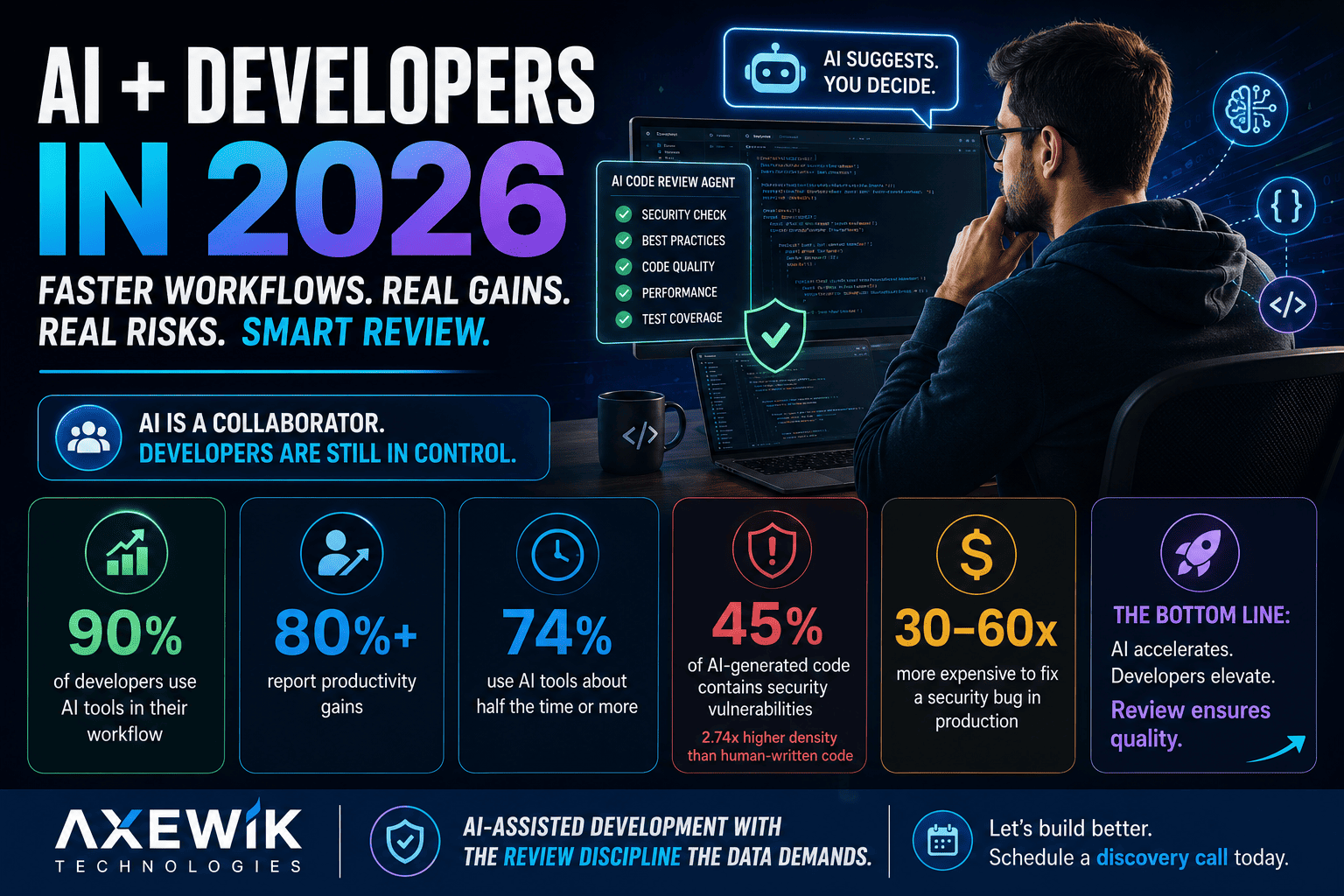
AI is now a daily collaborator for the large majority of developers - 90% use it in their workflow and over 80% report productivity gains, with 74% using it about half the time or more. But the real 2026 story is more nuanced than "AI writes your app": fully autonomous agentic coding remains early (61% of developers never use agent-based tools yet), and a real quality risk has emerged — roughly 45% of AI-generated code contains security vulnerabilities, at a vulnerability density 2.74x higher than comparable human-written code.
What Actually Changed
- Chat-based and in-IDE predictive suggestions dominate daily use because they're mature, simple, and easy to integrate - this is where the real, proven productivity gain lives today.
- More than 59% of software engineers using AI tools report measurable improvements in code quality when the tools are used with proper review discipline.
- Multi-agent code review setups are emerging as a genuine force multiplier for the review process specifically - an AI agent applying a checklist consistently, with the developer still fully in control of merge decisions.
- Framework matters more than people expect: a 30% AI-assisted productivity gain on a mainstream framework (React, Django) isn't matched on newer or less-common frameworks where AI tooling has less training coverage - factor this into stack decisions if your team leans heavily on AI assistance.
The Part Most "AI Coding" Articles Skip: The Real Risk Data
- 45% of AI-generated code contains security vulnerabilities, with vulnerability density 2.74x higher than human-written code, per recent supply-chain security research.
- Fixing a security defect in production costs 30-60x more than fixing it during development - meaning unreviewed AI-generated code isn't just a quality risk, it's a compounding cost risk.
- The practical industry response in 2026 is "parenting" AI coding tools, forcing smaller steps, requiring the tool to show its work, and validating outputs — rather than either banning AI coding or trusting it blindly.
What Hasn't Changed
Agentic (fully autonomous, multi-step) coding remains genuinely early - a majority of developers have never used agent-based coding tools in production work. This is a capability gap between "impressive demo" and "reliable daily tool," not evidence the technology has stalled, but it means claims of AI "replacing" development teams in 2026 are ahead of the actual adoption data.
What This Means for Choosing a Development Partner
Ask not "do you use AI tools" (nearly everyone will say yes) but specifically how AI-generated code gets reviewed before it reaches production — what scanning runs on it, whether it gets the same review rigor as human-written code, and how they handle the elevated vulnerability risk the data shows. That answer, not the "we use AI" claim itself, is the actual differentiator between teams shipping genuinely faster and teams accumulating invisible technical debt.
Want AI-Accelerated Development - With the Review Discipline the Data Demands?
At Axewik Technologies, AI-assisted development is part of our daily workflow, paired with the code-review and security-scanning discipline this post describes - because speed without review just moves the cost downstream. If you're scoping a build and want a partner who can explain exactly how AI-generated code gets validated before it ships, get in touch → for a discovery call.