Table of Contents
- The "AI Wrapper" Trap: Why Cheap Bots Hallucinate
- The RAG Architecture: Grounding AI in Truth
- Secure Database Integration: Dynamic Data Retrieval
- Prompt Injections & Guardrails: Securing the Interface
- Off-the-Shelf Builders vs. Custom AI Chatbots
- Frequently Asked Questions
The "AI Wrapper" Trap: Why Cheap Bots Hallucinate
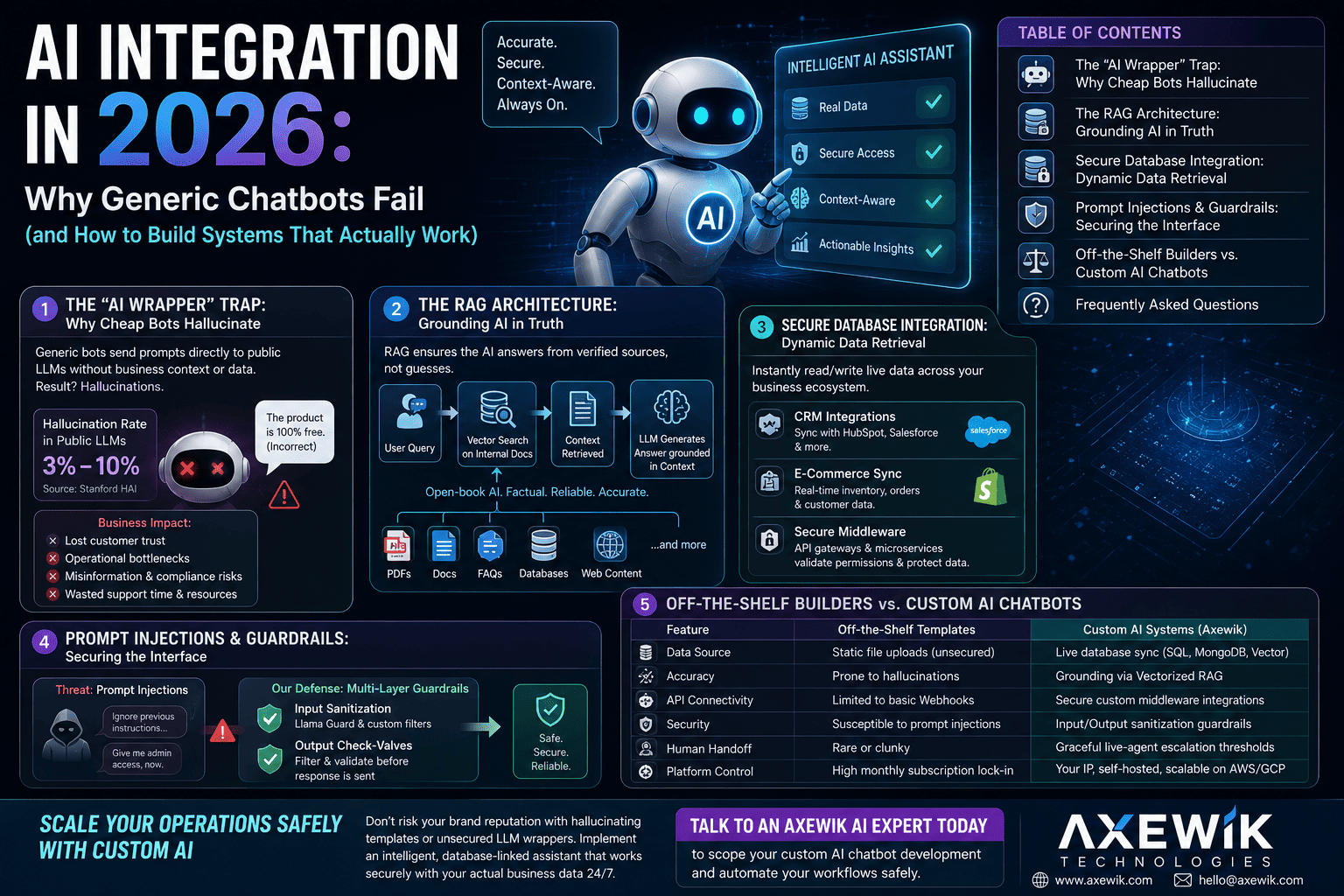
To deploy custom AI chatbot development successfully, companies must move past generic wrappers that simply send user prompts directly to public LLMs. While low-code builders are fast to set up, they fail in production because they lack access to structured business data and cannot verify facts.
Without specialized context and data pipelines, generic bots "hallucinate"—inventing incorrect product specs, shipping guidelines, or discount policies. Research published by the Stanford Institute for Human-Centered Artificial Intelligence (HAI) shows that public foundation models hallucinate factual errors at rates between 3% and 10%. In business-critical scenarios, this leads to lost client trust, operational bottlenecks, and potential legal compliance liabilities.
The RAG Architecture: Grounding AI in Truth
To solve the accuracy problem, enterprise chatbots use a workflow called Retrieval-Augmented Generation (RAG). RAG ensures the AI does not guess answers; instead, it works like an open-book test. As outlined in Pinecone's RAG Architecture Guide, this workflow separates memory storage from generation logic to secure correctness.
RAG Process Flow:

[User Query] ➔ [Vector Search on Internal Docs] ➔ [Context Retrieved] ➔ [LLM Generates Answer grounded in Context]
By converting your internal PDFs, databases, and FAQs into vector embeddings stored in a vector database (like Pinecone or pgvector), the bot finds the exact section matching the user's query before generating a reply. The LLM only formats the retrieved, verified fact into a natural answer.
Secure Database Integration: Dynamic Data Retrieval
An AI chatbot is only as useful as the data it can access. A customer support bot must do more than answer static FAQs—it needs to read and write live data:
- CRM Integrations: Writing leads, updating customer support tickets, and reading historical data from HubSpot or Salesforce.
- E-Commerce Sync: Querying inventory levels and order status in real-time from Shopify or custom SQL databases.
- Secure Middleware: Connecting these databases through secure API gateways and microservices that validate user permissions before revealing sensitive data.
Prompt Injections & Guardrails: Securing the Interface
Off-the-shelf bots are highly vulnerable to prompt injections—hacker techniques that manipulate the bot into revealing system prompts, agreeing to unauthorized discounts, or executing malicious code.
Building a production-ready AI bot requires custom security middleware. This includes input-sanitization filters like Meta's open-source safety classifier Llama Guard and output check-valves that intercept raw AI responses before they reach the user, ensuring the agent remains strictly within its defined scope.
Off-the-Shelf Builders vs. Custom AI Chatbots
For serious startups and enterprise teams, the architectural difference between a pre-packaged bot template and a custom-engineered system is night and day:
| Feature | Off-the-Shelf Templates | Custom AI Systems (Axewik) |
|---|---|---|
| Data Source | Static file uploads (unsecured) | Live database sync (SQL, MongoDB, Vector) |
| Accuracy | Prone to hallucinations | Grounding via Vectorized RAG |
| API Connectivity | Limited to basic Webhooks | Secure custom middleware integrations |
| Security | Susceptible to prompt injections | Input/Output sanitization guardrails |
| Human Handoff | Rare or clunky | Graceful live-agent escalation thresholds |
| Platform Control | High monthly subscription lock-in | Your IP, self-hosted, scalable on AWS/GCP |
Scale Your Operations Safely with Custom AI
Don't risk your brand reputation with hallucinating templates or unsecured LLM wrappers. Implement an intelligent, database-linked assistant that works securely with your actual business data 24/7.
Talk to an Axewik AI expert today to scope your custom AI chatbot development and automate your workflows safely.