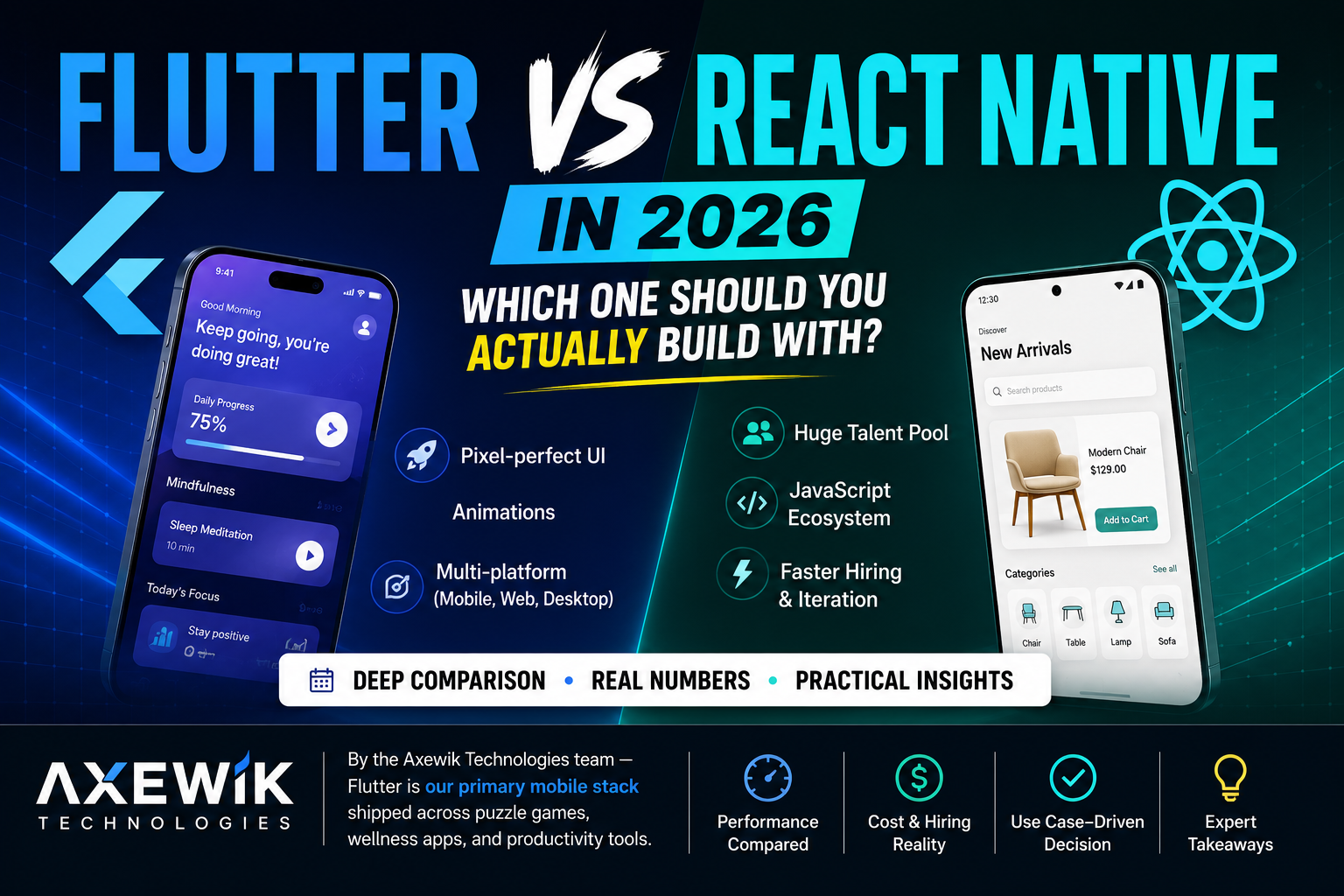
Both frameworks are production-mature in 2026 - Flutter holds roughly 46% of cross-platform market share, React Native around 35%, and for about 90% of apps the raw performance gap no longer decides the outcome. Flutter wins on pixel-perfect UI consistency, animation-heavy interfaces, and multi-platform reach (mobile, web, desktop from one codebase). React Native wins on hiring speed, JavaScript ecosystem reuse, and teams already invested in React. The right choice depends on your team's existing skills and your product's UI demands - not on a spec sheet.
What Actually Changed by 2026 (the debate isn't what it was in 2023)
Both frameworks closed their biggest historical weaknesses:
- React Native's New Architecture (Fabric renderer, JSI, TurboModules) replaced the old async JSON bridge with direct, synchronous communication - the performance complaint that used to define anti-React-Native arguments is largely gone.
- Flutter's Impeller engine replaced Skia as the default renderer on iOS and Android, precompiling shaders to eliminate the "jank" on first-run animations that used to be Flutter's weak point.
| Flutter | React Native | |
|---|---|---|
| Market share (2026) | ~46% | ~35% |
| Rendering | Own engine (Impeller) — pixel-identical on every platform | Native platform components via Fabric - looks platform-authentic |
| Frame rate (complex UI) | 58-60 FPS | ~51 FPS |
| Startup time | Slightly slower | ~200ms faster |
| Battery drain | Slightly higher | ~12% less |
| Language | Dart | JavaScript/TypeScript |
| Talent pool size | Smaller, but 25-30% higher productivity once onboarded | 3-5x larger |
| Hiring timeline | 6-8 weeks typical | 3-4 weeks typical |
| Multi-platform reach | Mobile, web, desktop, embedded — most mature | Mobile, web (via community tooling) |
| OTA updates without app store review | Less mature (Shorebird, newer) | Mature (Expo EAS Update) |
The honest takeaway: for the majority of business apps - content, commerce, internal tools - this table won't decide your project. What decides it is your team's existing skills and your UI ambitions.
The Decision That Actually Matters: Team + Product, Not Benchmarks
| Your situation | Go with |
|---|---|
| Team already knows React/JavaScript | React Native — productive within days, not weeks |
| Starting fresh, no existing team bias | Flutter — steeper 2-3 week Dart ramp-up, but stronger long-term consistency |
| Product needs a bespoke, animation-heavy, brand-identical UI across devices | Flutter — Impeller's pixel-perfect rendering is built for exactly this |
| Roadmap includes web + desktop from the same codebase | Flutter — currently the more mature multi-platform story |
| Need to hire fast and cheap | React Native — 3-5x larger talent pool |
| Building a game, puzzle mechanic, or custom animation-driven UX | Flutter — this is where it's genuinely the stronger technical choice |
| Rapid iteration via over-the-air JS updates without app store review cycles | React Native (Expo) — EAS Update remains the more mature OTA path |
What We've Actually Learned Building Production Flutter Apps
Most "Flutter vs React Native" articles compare specs. Here's what actually shows up once you're past the demo and into production, from apps we've shipped:
- Ball-sort/puzzle mechanics with custom animation rules (our Duotone Drop game) — this is squarely where Flutter's Impeller-driven frame consistency matters in practice, not just in a benchmark. A levels-based puzzle game with haptic feedback, particle effects, and daily-generated content needs animation that doesn't drop frames on mid-range Android devices, and that's a real, felt difference, not a marketing claim.
- Wellness/utility apps with heavy state and offline-first needs (brain-training and sleep/meditation apps) — Dart's sound null safety catches an entire category of state-management bugs at compile time that, in a comparable JS codebase, tend to surface as runtime crashes instead. This matters more than it sounds like on a spec sheet — it's fewer 2 AM production bugs, not a theoretical safety feature.
- The real cost driver isn't the framework — it's backend latency and architecture discipline. A 2-second API response will tank your UX regardless of whether you chose Flutter or React Native. If your team is deciding purely on framework benchmarks while the backend is an afterthought, that's the wrong place to be spending the decision-making energy.
Cost & Hiring Reality (2026 numbers)
- Senior Flutter developer: $135,000-$180,000/year (US market average)
- Senior React Native developer: $125,000-$160,000/year
- Flutter roles typically take 6-8 weeks to fill vs. 3-4 weeks for React Native, due to talent pool size
- Both frameworks save 30-60% versus building separate native iOS + Android apps
- Migrating an existing app between frameworks (either direction) typically runs $50,000-$250,000 for an enterprise app and 3-6 months - a decision worth getting right the first time rather than fixing later
By 2026, "which framework is better" is the wrong question - both are production-grade, well-funded, and closed their historical weaknesses. The right question is: what does your team already know, and what does your product's UI actually demand? If you want one deliberate opinion: for anything with custom, animation-heavy, brand-consistent UI - Flutter is where we'd bet our own build time, and it's why it's our default stack.
Axewik Technologies builds cross-platform mobile apps end-to-end- from puzzle games to wellness apps to production SaaS tools - primarily on Flutter, alongside React for web and Django for backend. If you're scoping a mobile build and want an honest read on which stack actually fits your project, [get in touch] for a discovery call.