By the Axewik Technologies team - builders of AxewikAI, a production AI SaaS platform
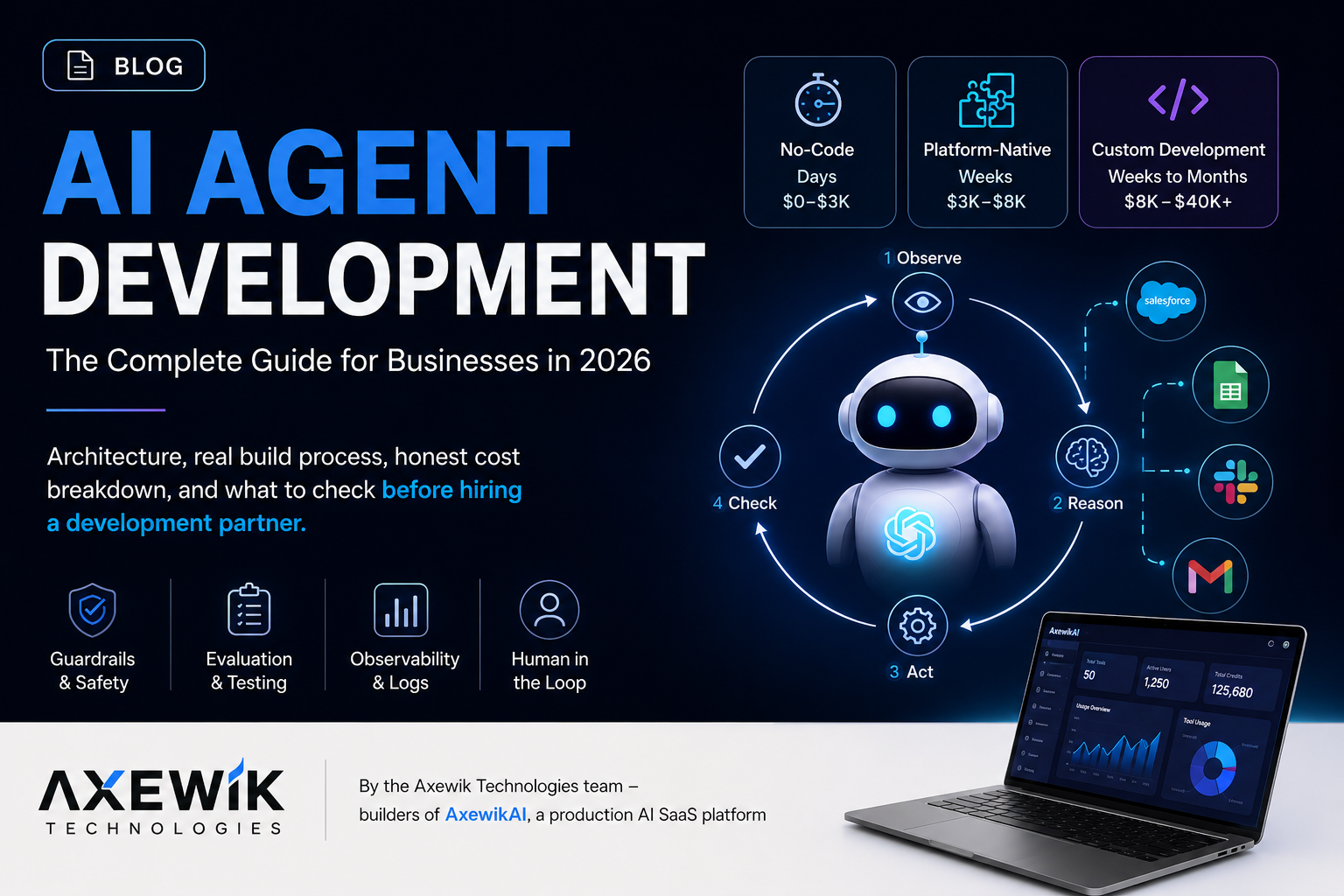
AI agents are software that pursues a goal instead of following a fixed script — they observe, decide, act through tools/APIs, check the result, and retry if something's off. In 2026, most businesses have three real build paths: no-code (days, $0-3K), platform-native agents (weeks, low cost, limited flexibility), or custom AI agent development (weeks-to-months, $8K-40K+ for an MVP, full control). Most agentic AI projects that fail don't fail on the model - they fail on integration, guardrails, and picking too broad a first use case. This guide breaks down the architecture, the real build process, honest cost ranges, and exactly what to check before hiring a development partner.
What Is an AI Agent, Really? (And Why It's Not a Chatbot)
A chatbot answers one question and stops. Traditional automation (Zapier, n8n, RPA) follows a fixed if-this-then-that script - reliable, but it breaks the moment a step it wasn't built for happens.
An AI agent is different: it's given a goal, not a script. It runs a loop - observe the current state, reason about what to do next, take an action through a tool or API, check whether that action actually worked, and adjust if it didn't - repeating until the job is done or it needs a human.
| Chatbot | Traditional Automation (Zapier/n8n) | AI Agent | |
|---|---|---|---|
| Responds to | Single prompt | Fixed trigger | A goal |
| Handles the unexpected | No | No — breaks | Yes — reasons and adapts |
| Multi-step, multi-system tasks | Rarely | Only if pre-mapped | Yes |
| Needs ongoing human steering | Every message | Only when it breaks | Only at decision checkpoints |
| Best for | FAQ, simple support | Repetitive, well-defined workflows | Workflows with judgment calls or messy inputs |
The practical failure mode worth knowing before you build one: an agent can return a confident, well-formatted answer that's simply wrong for the situation, with nothing in the logs flagging it. That's why guardrails and evaluation aren't optional extras - they're half the actual engineering work.
What Businesses Are Actually Automating With Agents in 2026
- Customer support — checking order status, updating customers, escalating only when it genuinely needs a human
- Sales & lead ops — qualifying inbound leads, tagging hot/warm/cold, booking calls, updating the CRM
- Back-office work — data entry between systems, report generation, invoice/reconciliation checks
- DevOps/IT — summarizing incidents, monitoring systems, and flagging anomalies faster than a human scanning dashboards
- E-commerce — inventory checks, return requests, personalized product responses
The common thread across all of these: a narrow, well-defined workflow with clear data access, not "automate my whole business." Agents that try to do everything at once are the ones that get abandoned after the pilot.
The Three Ways to Actually Build One
| Approach | Timeline | Typical Cost | Flexibility | Best For |
|---|---|---|---|---|
| No-code (n8n, Zapier, Make) | Days | $0–$3,000 | Low - breaks on edge cases | A single simple, well-defined workflow |
| Platform-native agent (built inside your existing CRM/SaaS tool) | 1–3 weeks | $3,000–$8,000 | Moderate - locked to that platform | Teams already committed to one platform's ecosystem |
| Custom AI agent development | 4–16 weeks | $8,000–$40,000+ for an MVP; $40K–$120K+ for multi-department systems | Full control | Workflows that touch multiple systems, need real guardrails, or handle judgment calls |
Most businesses should start with the cheapest option that could plausibly work, and only move to custom development once a no-code version has proven the workflow is worth automating and hit its ceiling.
How a Custom AI Agent Actually Gets Built (a real technical walkthrough)
Most guides on this topic stay at the concept level. Having built AxewikAI, a config-driven platform running roughly 50 AI tools in production, with a provider abstraction layer, credit-based usage ledger, and background job processing - here's what the architecture actually looks like under the hood:
- Discovery — map the exact workflow, the systems it touches, and what "success" means in measurable terms (this week determines whether the agent works in production; skipping it is the #1 reason projects stall).
- Provider/model selection — which foundation model fits the task, and critically, a provider abstraction layer so you're not locked to one vendor if pricing or capability shifts later.
- Tool/API integration layer — the agent's actual hands: CRM, database, payment processor, email, whatever the workflow needs to touch.
- Memory & state — does the agent need to remember context across sessions, or is each run independent? This decision shapes the whole data layer.
- Guardrails & approval checkpoints — hard limits on what the agent can do autonomously vs. what requires human sign-off (financial actions, customer-facing commitments, anything irreversible).
- Evaluation harness — a way to test the agent against real, messy data before it ever touches production - not just a clean demo dataset.
- Observability — logging every decision the agent makes so a human can audit why it did something, not just what it did.
- Staged rollout — shadow mode (agent suggests, human approves) before full autonomy on any sensitive action.
This is also exactly why a fixed price quoted before discovery is a red flag - agent complexity depends entirely on your data and systems, and nobody can estimate that sight unseen.
What Actually Causes AI Agent Projects to Fail
Industry research puts the enterprise AI pilot failure rate above 70%, and the pattern is consistent: an impressive demo, a messy integration, an abandoned proof of concept. The specific causes worth watching for:
- Scope too broad for a first project — "automate customer service" instead of "handle order-status questions"
- No paid pilot before full commitment — skipping this typically adds months of rework later, not saves time
- A vendor selling chatbots as "agents" — ask for an architecture diagram; it exposes this immediately
- No guardrails or escalation path — the agent making irreversible decisions with no human checkpoint
- No evaluation against real data — only tested against a clean demo scenario
How to Choose a Development Partner - Checklist
- Can they show a production deployment, not just a demo?
- Do they require (or offer) a paid pilot before a full engagement?
- Can they explain failure modes unprompted - hallucination handling, stuck loops, escalation paths?
- Do they have real integration experience with your actual systems (CRM/ERP/payments), not just API awareness?
- Do they refuse to quote a fixed price before a discovery phase? (Good sign, not a bad one.)
- Is IP ownership 100% yours after delivery?
- Can they name a project that didn't go as planned, and what they changed because of it? (Every honest team has one.)
The technology has moved past demos - the businesses winning with AI agents in 2026 are the ones that picked one narrow, well-defined workflow, built proper guardrails and evaluation from day one, and treated the discovery phase as the most important week of the project, not a formality before the "real work" starts.
Axewik Technologies builds custom software, AI/automation systems, and SaaS platforms - including AxewikAI, our own multi-tool AI platform built on Django with a provider abstraction layer and credit-based usage system. If you're scoping an AI agent for a specific workflow, [get in touch] for a discovery call.